Groups of four notes alternate with chords and rests. You connect positions, slurs and sustained basses. The study has two repeated sections. The app uses 60 as a practice tempo.
Skills to prepare
- Sixteenth-note scales
- Hammer-ons and pull-offs
- Position shifts
- Partial barres
- Sustained bass notes
- Natural harmonic
- Trills
Before learning the piece
- App checkpoint: play bar 1 evenly, four notes per click, three times in a row. Practise this skill.
- App checkpoint: play the slurs in bar 16 without a new right-hand attack on their second notes. Practise this skill.
- App checkpoint: sound both chords in bar 3 without moving your index finger from fret 7. Practise this skill.
These checkpoints belong to our learning path. They do not set a deadline for your progress.
Tablature and fingerings
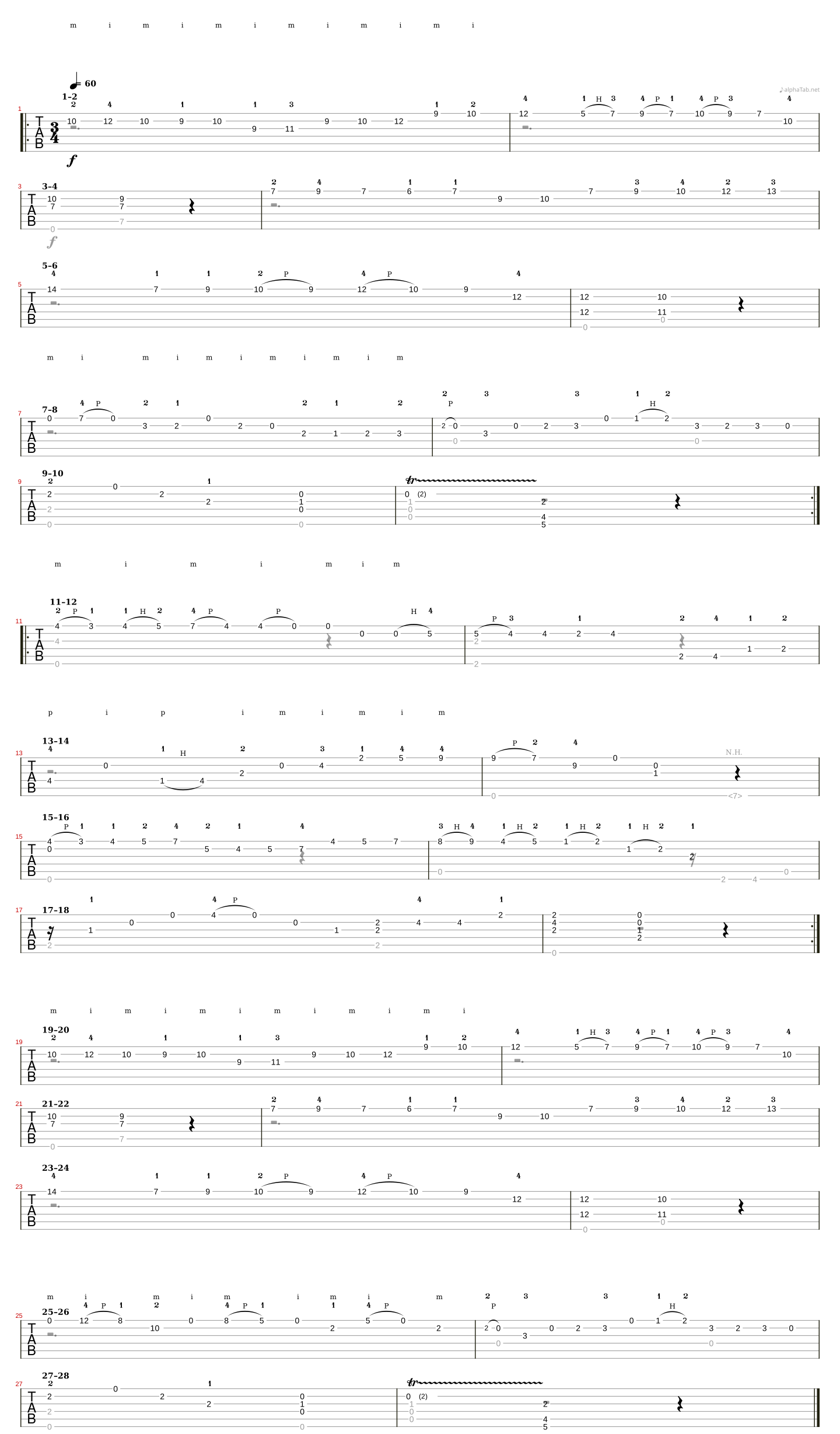
The six lines represent the strings, with high E at the top. Numbers show frets; 0 means an open string. The letters p, i, m and a indicate right-hand fingers.
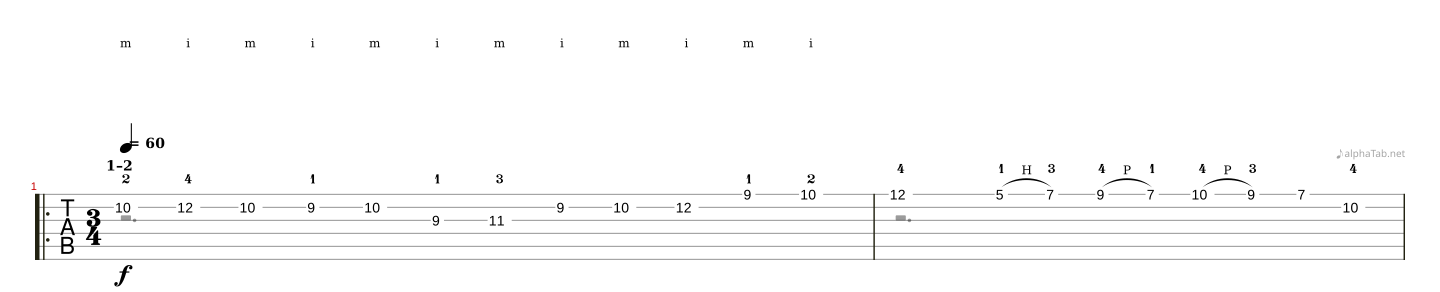
Read the complete static tab · Download the alphaTex file
The player and its sounds load when you choose to use them.
Your phrase-by-phrase plan
Work on a short passage. Aim for five clean attempts in a row, then connect two phrases. Bar numbers follow our transcription, including a separately numbered pickup where applicable.
Phrase 1 · bars 1–2
In bar 1, alternate m-i with four notes per beat. Aim for each landing before speeding up. In bar 2, isolate the 5–7 hammer-on on string 1. Place your ring finger at 7, then prepare the position shift.
Phrase 2 · bars 3–4
In bar 3, keep your index finger at 7 for both chords, then observe the rest. In bar 4, practise the last four notes alone: frets 9, 10, 12 and 13 on string 1.
Phrase 3 · bars 5–6
In bar 5, hold the first note for one beat. Then prepare the shift from 14 back to 7. In bar 6, let the open basses ring under both chords.
Phrase 4 · bars 7–8
In bar 7, the 7–0 pull-off gets only one right-hand attack. In bar 8, play the short groups slowly. Hold open string 4 for the first two beats, then play it again on beat three.
Phrase 5 · bars 9–10
In bar 9, hold both bass notes for two beats. In bar 10, alternate 0 and 2 on string 2 for the trill. The last chord is followed by one beat of rest. Repeat from bar 1.
Phrase 6 · bars 11–12
In bar 11, hold the low bass and fret 4 on string 3 for two beats. In bar 12, set the small barre at 2 before starting. The thumb plays the four bass notes on the last beat.
Phrase 7 · bars 13–14
In bar 13, keep the 1–4 hammer-on on string 4. In bar 14, hold open string 6 for two beats. On beat three, touch it lightly above the seventh fret for the harmonic.
Phrase 8 · bars 15–16
In bar 15, keep the four notes in each group even. In bar 16, do not pluck the second note of each slur with the right hand. After the slurs, the thumb plays 2, 4 and 0 on the bass strings.
Phrase 9 · bars 17–18
In bar 17, the bass starts alone, then the arpeggio rises. Hold that bass for two beats. In bar 18, sound both chords, then observe the rest. Repeat from bar 11.
Phrase 10 · bars 19–20
Bars 1–2 return. In bar 19, keep alternating m-i. In bar 20, prepare each position after the slur without shortening the first sustained note.
Phrase 11 · bars 21–22
Bars 3–4 return. In bar 21, hold the barre at 7 through both chords. Use the rest to prepare the start of bar 22.
Phrase 12 · bars 23–24
Bars 5–6 return. In bar 23, prepare the large shift back to fret 7. In bar 24, listen to the two open basses under the chords.
Phrase 13 · bars 25–26
In bar 25, aim first for the indicated frets 12, 8 and 10. The slurs then descend from 8 to 5, then 5 to 0 on string 1. In bar 26, return to the pattern from 8 with its sustained bass.
Phrase 14 · bars 27–28
The cadence from bars 9–10 returns. In bar 28, trill between 0 and 2 on string 2, then set the final chord. Leave the last beat silent. There is no final repeat.
Watch and listen
Choose the recording that matches your current goal. Videos load only when you select them and require an internet connection.
Performance · guitarprof
Listen to Philip Hemmo's performance. Find the fast groups and the rests between responses. This link is a performance, not a lesson.
English commentary. Link and metadata checked for our selection.
Performance · Patrik Kleemola
Compare Patrik Kleemola's phrasing. Watch the shifts without trying to match his tempo. This link is a performance, not a lesson.
English commentary. Link and metadata checked for our selection.
Sources and transcription choices
- Tárrega — Estudio en forma de Minuetto, Orfeo Tracio, plate 1103, printed pages 2–3
- Werner — practising scales: alternation, landing points and the quality of each note
The notes follow the credited sources. Fingerings, phrase divisions and practice tempos are editorial learning choices. How our transcriptions work.