Hammer-ons and pull-offs let the left hand produce a new note without a separate right-hand attack. Start with a small pair of notes and listen to the arrival. It should remain clear and belong to the same rhythmic gesture, rather than disappearing or becoming an accidental accent.
For an ascending slur, find the destination accurately before adding speed. For a descending slur, prepare the lower note and examine how the moving finger releases the string. Compare short attempts with the same fingering and volume. Changing several details at once makes it difficult to hear which adjustment helped.
Work on the group alone, then add the note immediately before and after it. That connection matters because an ornament that sounds clear in isolation may still rush the following beat. Keep the surrounding rhythm steady while giving the slurred notes their intended place within it.
Return to the exact phrase that contains the movement. Listen for the melody and any voice that needs to remain held underneath. A slur exercise should make the musical passage easier to control; it should not encourage a larger or more forceful movement than the phrase actually needs.
What this exercise helps you change
- Weak second note
- Uneven rhythm
- Inaccurate little finger
Your practice steps
1. Warm up first
Play scales or arpeggios for at least ten minutes before slurs. Keep your hand relaxed.
Your checkpoint: You have completed ten minutes of playing beforehand.
2. Compare two attacks
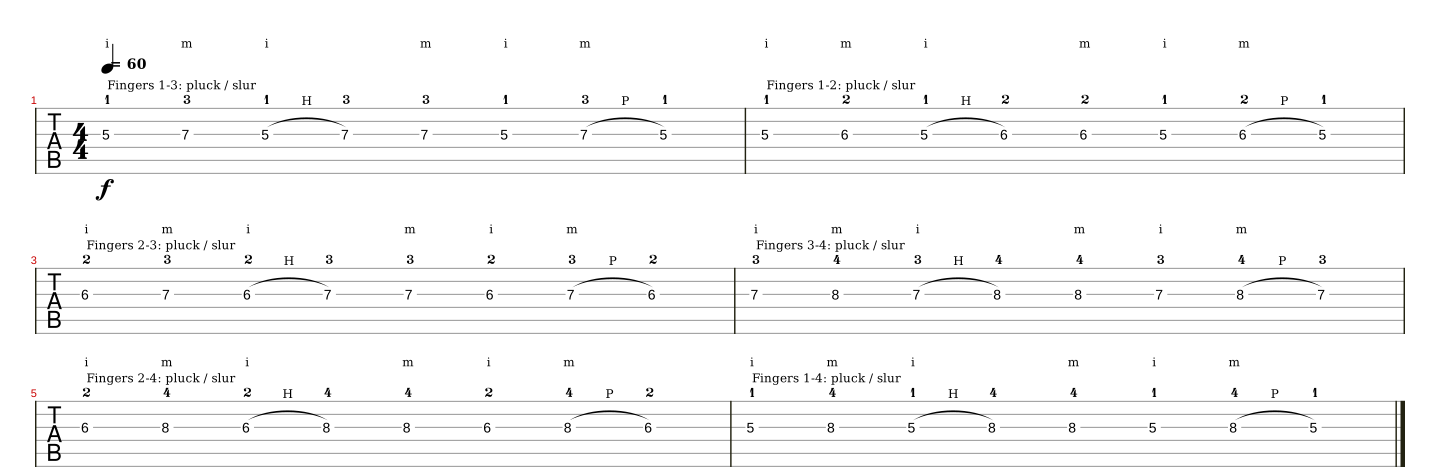
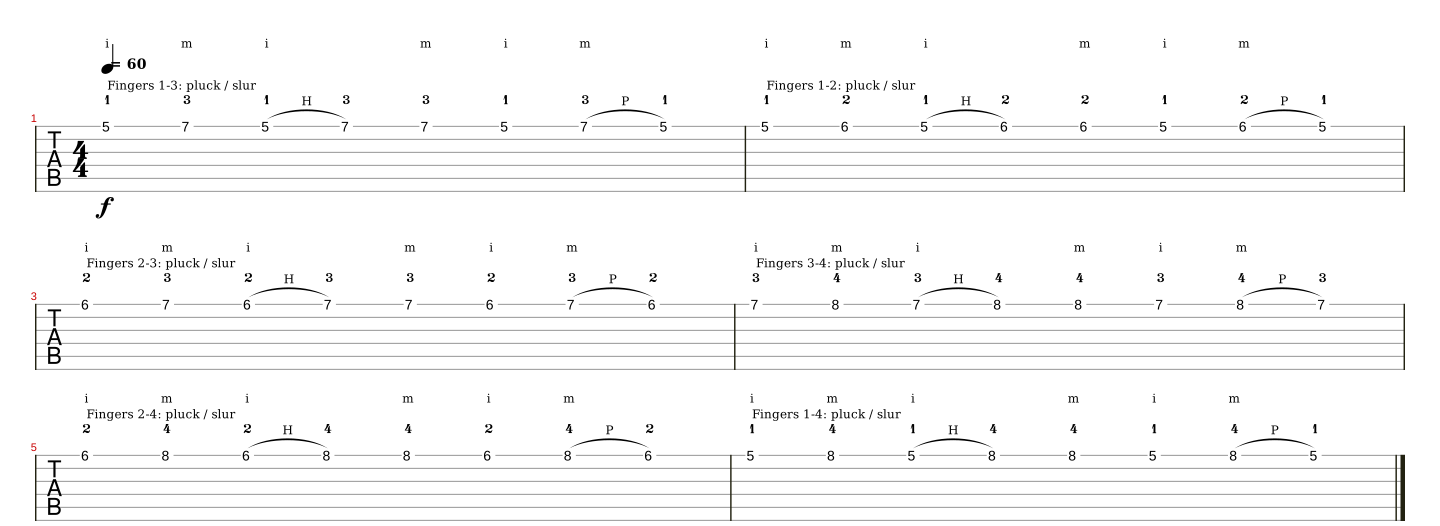
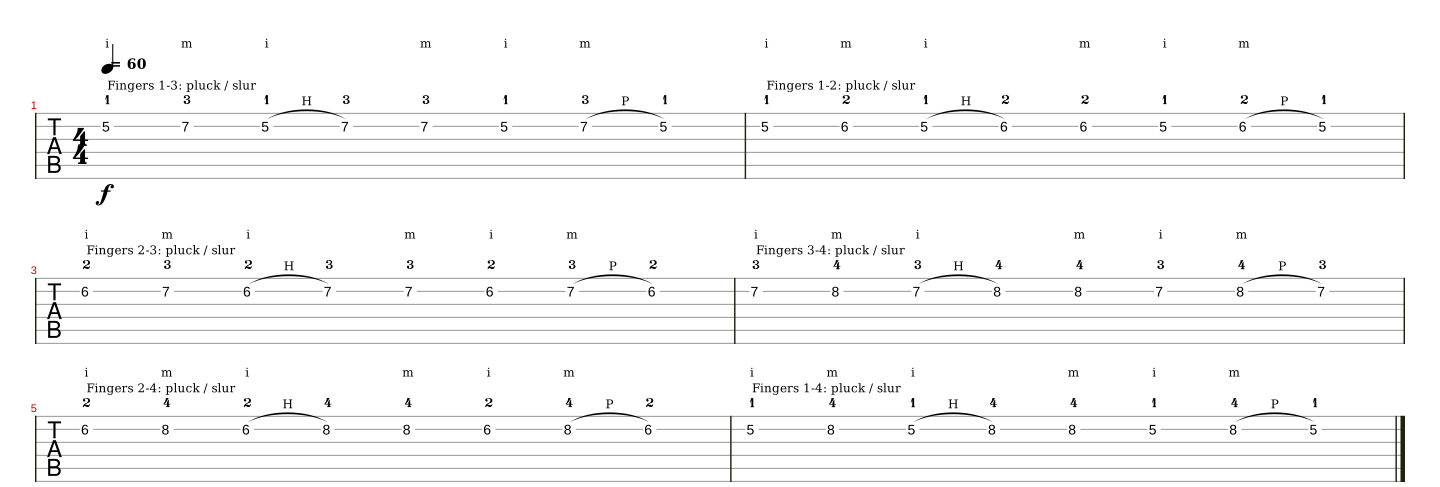
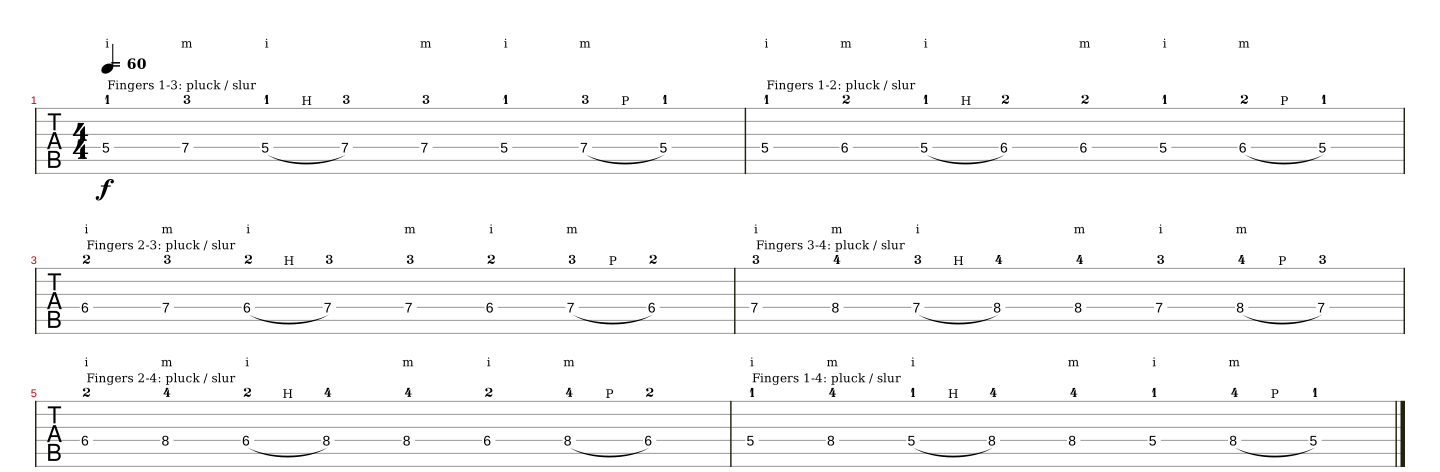
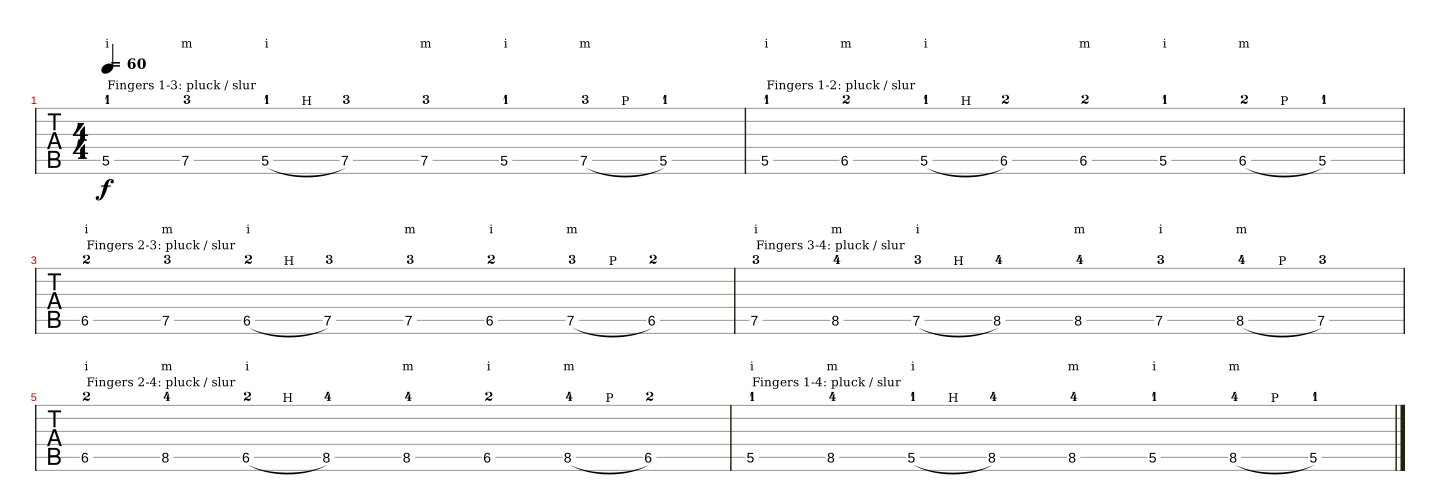
On string 3, play frets 5 and 7 with fingers 1 and 3, plucking each note. Play the same pair again with only one right-hand attack.
String 3 = G; frets 5 and 7 = C and D. Then use 1-2, 2-3, 3-4, 1-3, 2-4, 1-4 on all six strings, ascending and descending. One pair per click.
Practice reference: 60 bpm · 2 attacks per click.
Your checkpoint: The slurred pair keeps the rhythm and volume of the plucked pair.

Read the complete static tab · Download the alphaTex file
The player and its sounds load when you choose to use them.
Other versions to read
3. Prepare the hammer-on
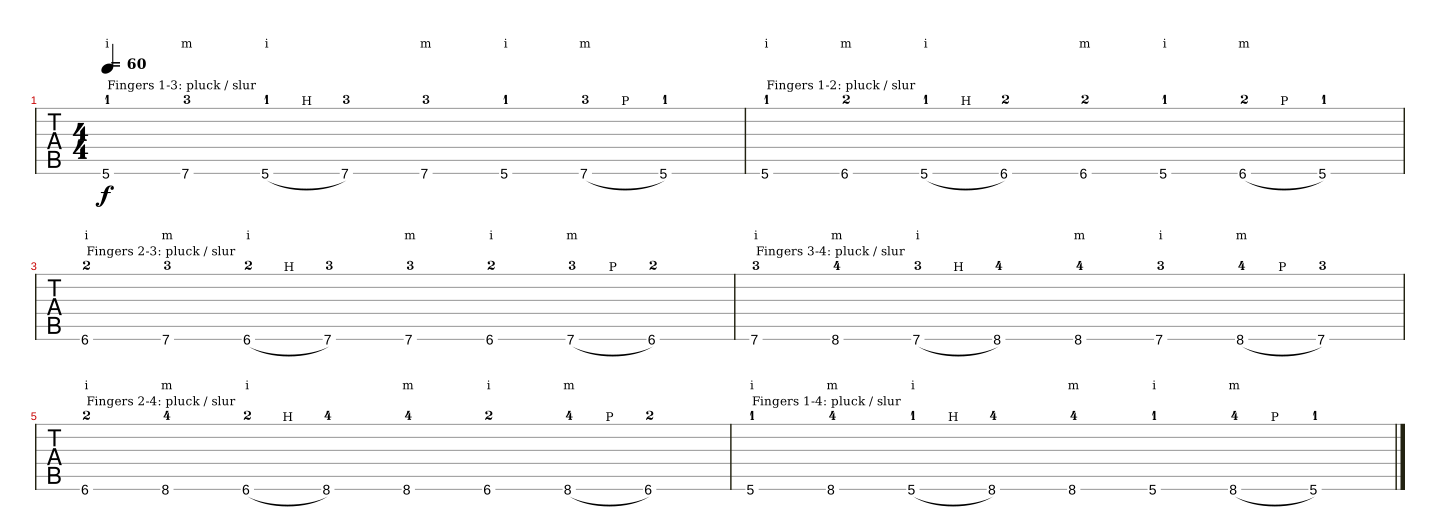
Hover the next finger just above its fret. Drop it with a short movement just behind the fret wire.
The speed of the movement sounds the note; a large movement is unnecessary.
Practice reference: 60 bpm · 2 attacks per click.
Your checkpoint: The second note sounds as clearly as the first.
Read the complete static tab · Download the alphaTex file
The player and its sounds load when you choose to use them.
4. Keep the lower finger down
To pull off, keep the lower finger down and lightly pluck the string with the departing finger. Do not pull the lower finger away with it.
The departing finger may finish against the next string towards the treble, like a left-hand rest stroke; adapt the movement on the first string.
Practice reference: 60 bpm · 2 attacks per click.
Your checkpoint: The destination note stays clear and in time.
Read the complete static tab · Download the alphaTex file
The player and its sounds load when you choose to use them.
5. Work with one fixed finger
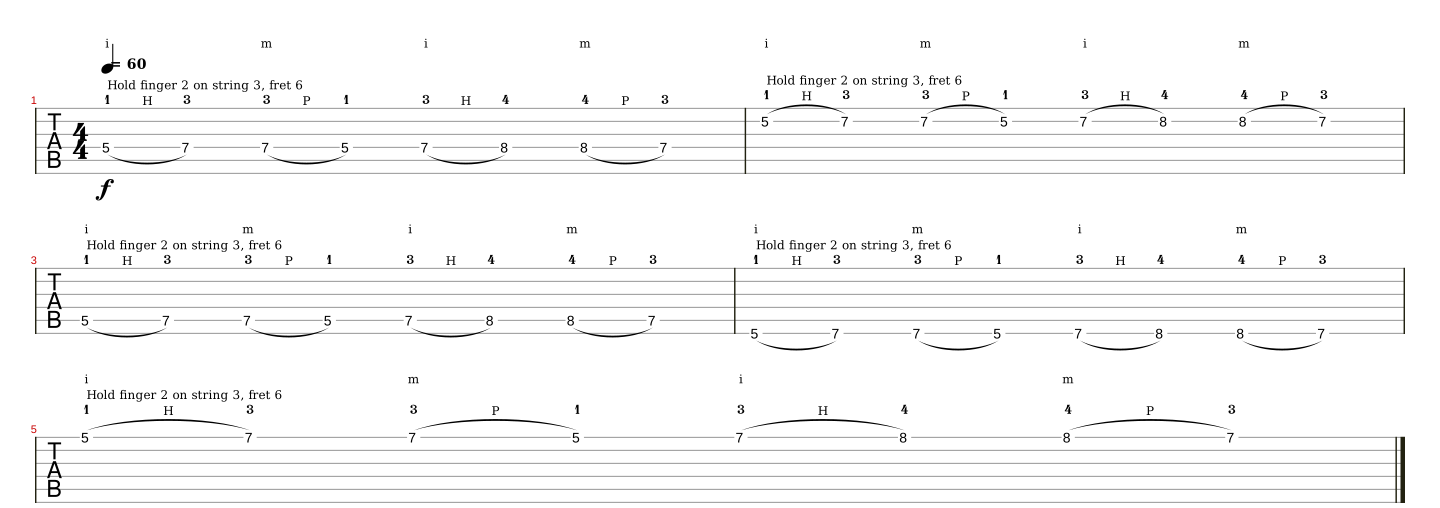
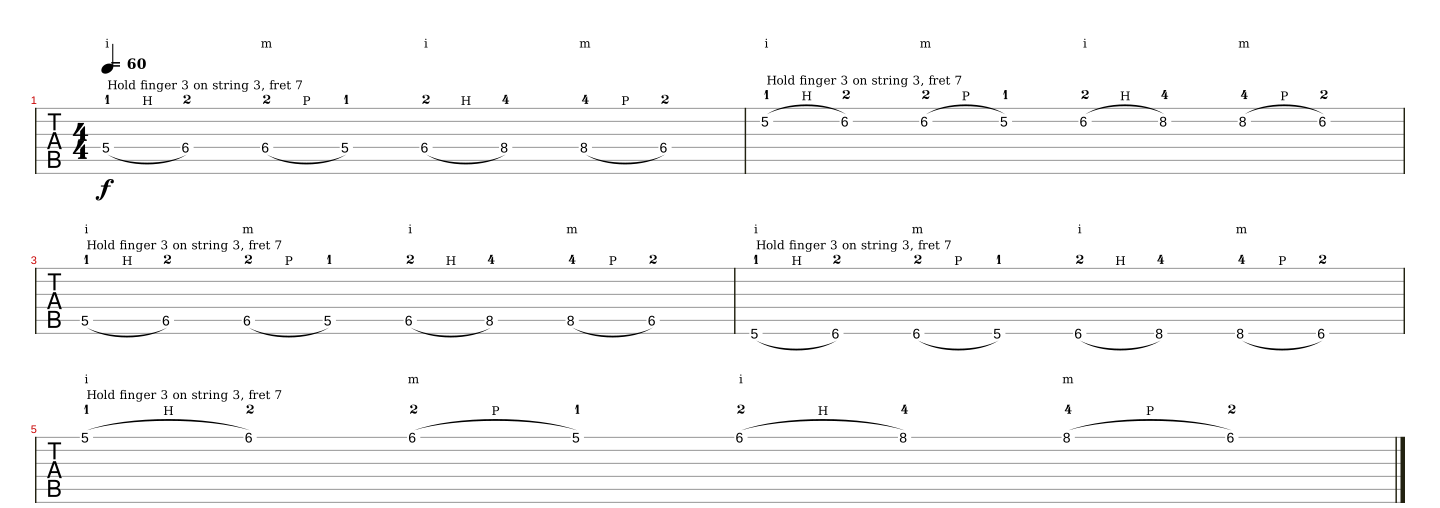
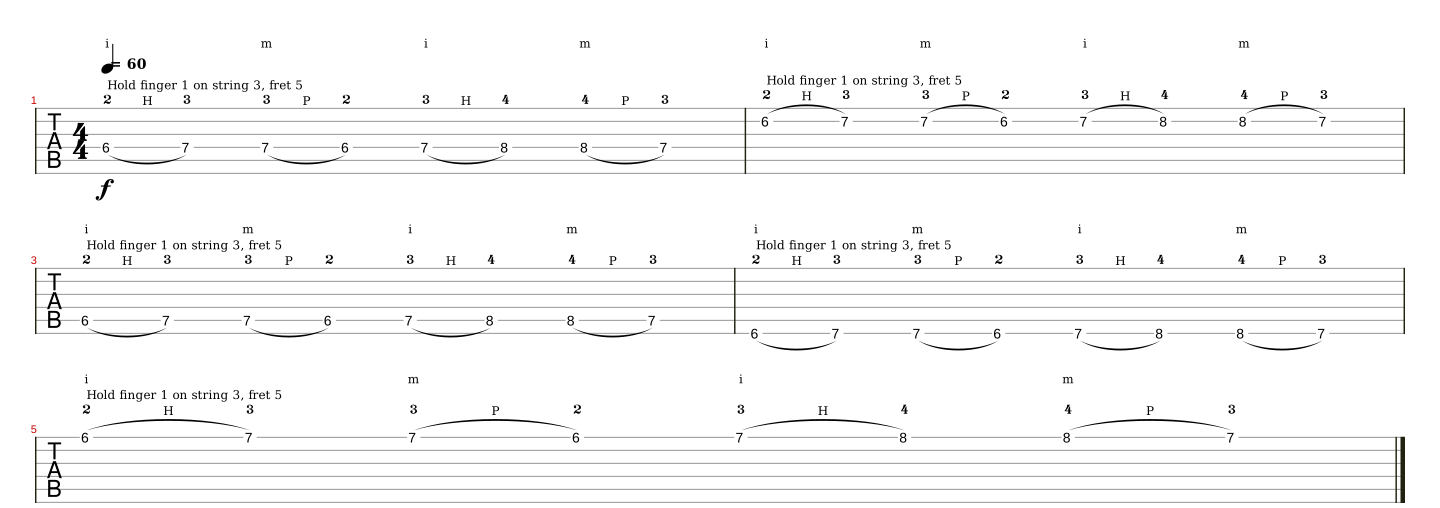
Keep finger 2 at fret 6 on string 3. Play 1-3, then 3-4 slurs on neighbouring strings.
Start on string 4, then 2, 5, 6 and 1. Next, fix 3 to play 1-2 and 2-4, then fix 1 for 2-3 and 3-4; favour the weaker pair.
Practice reference: 60 bpm · 2 attacks per click.
Your checkpoint: The fixed finger stays in place without unnecessary pressure.

Read the complete static tab · Download the alphaTex file
The player and its sounds load when you choose to use them.
Other versions to read
6. Link the combinations
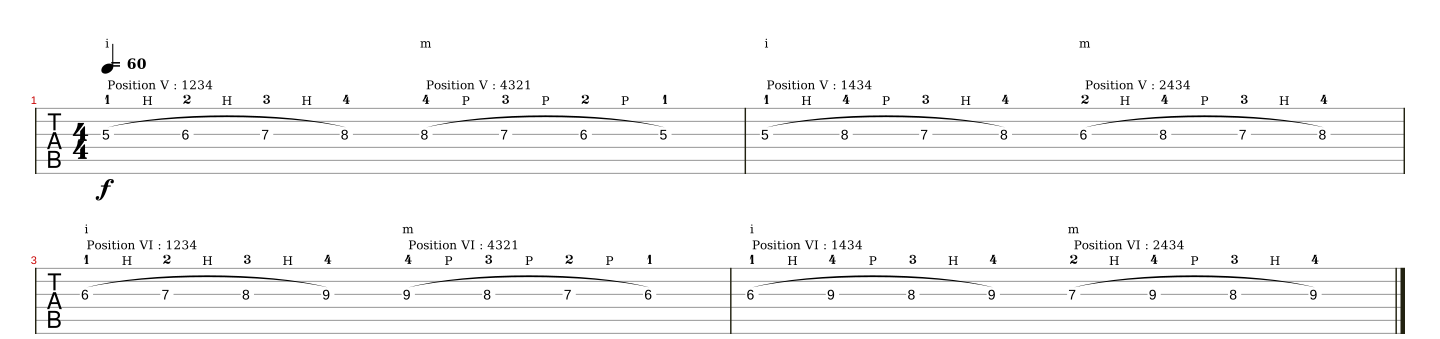
On one string, slur 1-2-3-4, 4-3-2-1, 1-4-3-4, then 2-4-3-4. Shift one fret, then change strings.
Do not fit every variation into a short block: choose the one that addresses today's problem.
Your checkpoint: The little finger keeps an even tone with the others.

Read the complete static tab · Download the alphaTex file
The player and its sounds load when you choose to use them.
Common difficulties and corrections
The second note is weak.
Prepare the finger above the fret and shorten its hammer-on movement.
Return to step 3You rush the second note.
Compare the plucked pair with the slurred pair again, one pair per click.
Return to step 2The pull-off note is muted.
Keep the lower finger down while the other lightly plucks the string.
Return to step 4The fixed finger lifts.
Slow down and reduce the stretch until the fixed finger stays in place.
Return to step 5The little finger is inaccurate.
Repeat 1-4-3-4, then 2-4-3-4 slowly, using a short movement.
Return to step 6You start slurs without warming up.
Return to scales and arpeggios until you have warmed up for ten minutes.
Return to step 1Watch and listen
Choose the recording that matches your current goal. Videos load only when you select them and require an internet connection.
Lesson · SiccasGuitars
Before working on hammer-ons and pull-offs.
English commentary. Link and metadata checked for our selection.
Lesson · This is Classical Guitar
Choose the chapter for your variation.
English commentary. Link and metadata checked for our selection.
Lesson · This is Classical Guitar
To review the two basic movements.
English commentary. Link and metadata checked for our selection.
Sources and transcription choices
- Niedt — Left-hand exercises
- Werner — Hammer-ons and pull-offs
- Classical Guitar Corner — 7 exercises
- Classical Guitar Shed — 1234-4321-1434-2434
The notes follow the credited sources. Fingerings, phrase divisions and practice tempos are editorial learning choices. How our transcriptions work.
Apply the skill in a piece
- Lágrima
- Adelita
- Endecha
- Prelude No. 2 in A minor
- Marieta
- Pavana
- Rosita
- Sueño — Mazurka
- María
- Mazurka in G
- Las dos hermanitas — Two Waltzes
- Isabel — Waltz
- Paquito — original version ¡Sola!
- Tango — Alier edition
- Gran Vals
- Capricho Árabe
- Danza Mora
- Carcassi — Study Op. 60 No.7
- Estudio en forma de Minuetto
- Aguado, Nuevo método, lesson 31 — first section: small barres
- Sor — Study Op. 35 No. 17
- Tárrega — Prelude in D minor
- Tárrega — Prelude in E major
- Tárrega — Prelude in D major (No.10)
- Tárrega — Prelude in D major (No.11)
- Tárrega — Preludio in E major (No. 12, Anido)
- Tárrega — Prelude in A minor (No. 13, Anido)
- Tárrega — Preludio in G major (No. 3)