A six-note arpeggio on each beat moves through changing chords. The melody passes from the inner voices to the treble, then to the bass. You work on evenness and shifts. The app uses 60 as a practice tempo.
Skills to prepare
- p-i-m-a-m-i arpeggios
- Six notes per beat
- Position shifts
- Sustained bass notes
- Melody and accompaniment
Before learning the piece
- App checkpoint: play p-i-m-a-m-i evenly for 20 seconds, three notes per click. Practise this skill.
- App checkpoint: play the treble notes of bars 11–12 alone, then keep that melody audible within the arpeggio. Practise this skill.
- App checkpoint: sound the four strings of the shape in bar 14 separately, three times in a row. Practise this skill.
These checkpoints belong to our learning path. They do not set a deadline for your progress.
Tablature and fingerings
The six lines represent the strings, with high E at the top. Numbers show frets; 0 means an open string. The letters p, i, m and a indicate right-hand fingers.

Read the complete static tab · Download the alphaTex file
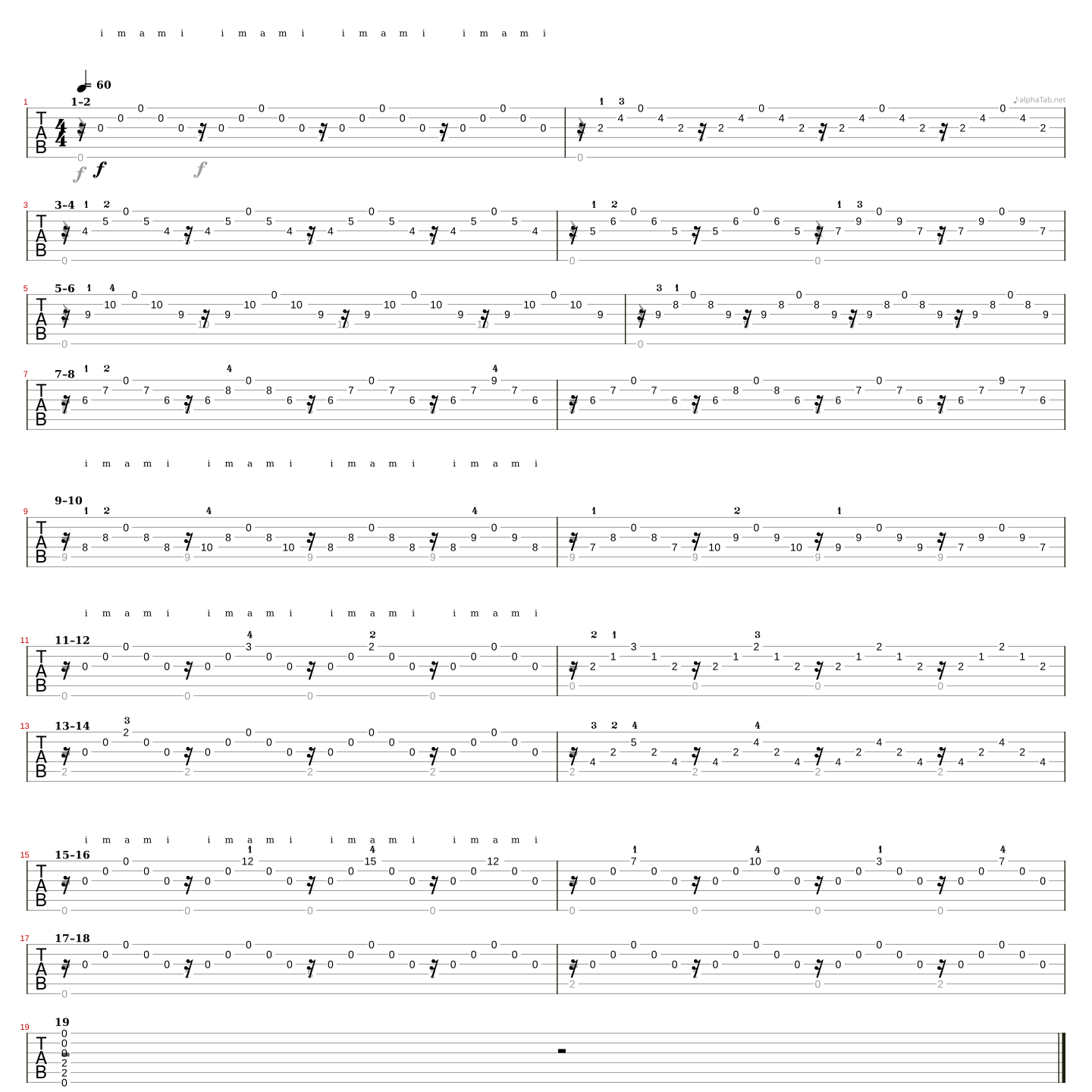
The player and its sounds load when you choose to use them.
Your phrase-by-phrase plan
Work on a short passage. Aim for five clean attempts in a row, then connect two phrases. Bar numbers follow our transcription, including a separately numbered pickup where applicable.
Phrase 1 · bars 1–2
Keep the p-i-m-a-m-i pattern. Each beat has six notes: count two groups of three. In bars 1–2, let open string 6 ring through the other bass notes.
Phrase 2 · bars 3–4
In bar 3, strings 1 and 2 play the same pitch. Keep both attacks. In bar 4, prepare the two positions before joining them. The low bass returns on beat three.
Phrase 3 · bars 5–6
In bar 5, check the three fingers placed at frets 9 and 10. In bar 6, the note on string 2 descends to fret 8. The right-hand pattern stays the same.
Phrase 4 · bars 7–8
In bars 7–8, keep the two fingers steady on strings 4 and 3. String 2 alternates between 7 and 8. Prepare fret 9 on string 1 for the last group.
Phrase 5 · bars 9–10
In bars 9–10, move the right hand to strings 5, 4, 3 and 2. String 2 stays open. Practise the change from bar 8 to 9 separately, very slowly.
Phrase 6 · bars 11–12
In bars 11–12, first play the highest note in each group to hear the melody. Then add the other five notes. Keep the accompaniment lighter.
Phrase 7 · bars 13–14
In bar 13, the first treble note descends to open string 1. In bar 14, all four left-hand fingers are used. Sound each position before restarting the arpeggio.
Phrase 8 · bars 15–16
In bar 15, move from open string 1 to frets 12 and 15. In bar 16, aim for 7, 10, 3 and 7 in turn. Keep strings 2 and 3 open during these shifts.
Phrase 9 · bars 17–18
In bars 17–18, play the bass notes alone first. In bar 17, fret 5 on string 4 and open string 3 give the same pitch. Keep both attacks in place.
Phrase 10 · bar 19
Final segment: one bar. Set the E minor chord, then observe the rest. The player sounds the chord together and keeps a fixed tempo.
Watch and listen
Choose the recording that matches your current goal. Videos load only when you select them and require an internet connection.
Lesson · Classical Guitar Rocks
Watch the pattern without spoken commentary. Compare the position shifts and the fingers' return. The fingerings may differ from the app's.
English commentary. Link and metadata checked for our selection.
Lesson · Robert Lunn
Follow the full lesson in English. Practise the position changes in small groups before returning to a continuous flow.
English commentary. Link and metadata checked for our selection.
Sources and transcription choices
- Giuliani — Esercizio Op. 48, Haslinger, plate S. u. C. 2113; Boije 138, pages 5–6
- Philip Hii — p-i-m-a-m-i pattern and practising the melody alone
- Rhayn Jooste — shifts, finger preparation and the study's voices
The notes follow the credited sources. Fingerings, phrase divisions and practice tempos are editorial learning choices. How our transcriptions work.