Tárrega
Tárrega — Prelude in E major (No. 4)
Detached chords
Level 5/5 · 49 bars · Practice tempo · 76 bpm
Count three eighth notes and detach the chords while sustaining the notes Tárrega marks long. Practise the position changes without a fixed tempo first. The original marking is Allegro; 76 quarter notes per minute is a practice reference.
Skills to prepare
- Detached chords
- Barres and position changes
- Slurred grace notes
Before learning the piece
- Sound the notes of a seventh-fret barre separately before playing them together. Practise this skill.
- Play a pull-off three times, keeping the destination as clear as the first note. Practise this skill.
These checkpoints belong to our learning path. They do not set a deadline for your progress.
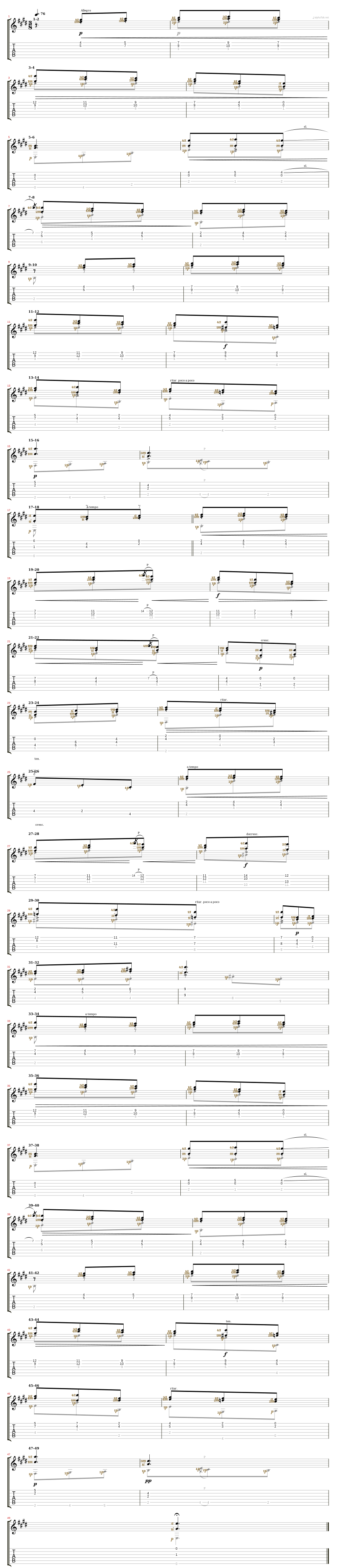
Tablature and fingerings
The six lines represent the strings, with high E at the top. Numbers show frets; 0 means an open string. The letters p, i, m and a indicate right-hand fingers.

Read the complete static tab · Download the alphaTex file
The player and its sounds load when you choose to use them.
Your phrase-by-phrase plan
Work on a short passage. Aim for five clean attempts in a row, then connect two phrases. Bar numbers follow our transcription, including a separately numbered pickup where applicable.
Phrase 1 · bars 1–2
Count the opening rest as the first of three eighths, then bring the two voices in together.
Phrase 2 · bars 3–4
Keep the inner E at fret nine through bar 3, then release the barre to move down towards the open strings.
Phrase 3 · bars 5–6
Let the upper chord in bar 5 ring through all three thumb strokes; detach only the bass notes.
Phrase 4 · bars 7–8
At the start of bar 7, slide into the small B, then pluck that B again with the chord.
Phrase 5 · bars 9–10
Play the lone low B in bar 9 before the two upper chords; the thumb waits until the next bar.
Phrase 6 · bars 11–12
On the second eighth of bar 12, listen for E-sharp between the two C-sharps even as you accent the top note.
Phrase 7 · bars 13–14
In bar 14, bring out the D-natural on the second eighth as you slow towards the open bass A.
Phrase 8 · bars 15–16
In bar 16, hold both upper notes and pull the small D-sharp off to C-sharp without adding an eighth.
Phrase 9 · bars 17–18
Recover the pulse at “a tempo” in bar 17 and continue straight across the double bar.
Phrase 10 · bars 19–20
In bar 19, prepare E at fret twelve before pulling off from F-sharp at fret fourteen.
Phrase 11 · bars 21–22
On the second string in bar 21, let the grace F-sharp resolve to E without masking the inner B.
Phrase 12 · bars 23–24
Prepare the second-position chord in bar 24 by moving the thumb towards the sixth string before its F-sharp.
Phrase 13 · bars 25–26
Sing F-sharp, E, C-sharp with the three bass notes of bar 25, then resume the tempo on B in bar 26.
Phrase 14 · bars 27–28
Keep the high slur in bar 27 light so the accent on the second eighth of bar 28 remains the peak.
Phrase 15 · bars 29–30
At the end of bar 29, set the seventh-fret barre before placing finger two at fret eight on the fifth string.
Phrase 16 · bars 31–32
In bar 32, hold both upper notes at fret nine through the bass rest and the two bass replies.
Phrase 17 · bars 33–34
In bar 33, play the first chord together with its bass B: this return begins on the first eighth.
Phrase 18 · bars 35–36
In the descent in bar 36, release pressure between positions to reach the open-string chord without scraping.
Phrase 19 · bars 37–38
In bar 37, listen for E, G-sharp, B below the held chord and prepare the slide at the end of bar 38.
Phrase 20 · bars 39–40
Separate the three chords in bar 39 by easing finger pressure; keep the hand near the neck for bar 40.
Phrase 21 · bars 41–42
After the low B in bar 41, use the two upper chords to aim for the position of the inner E in bar 42.
Phrase 22 · bars 43–44
Give the “ten.” in bar 44 some weight without adding an eighth; the last chord still falls on three.
Phrase 23 · bars 45–46
Begin slowing in bar 46 as you listen to the bass move from E to G-sharp and then to A.
Phrase 24 · bars 47–49
Move from piano in bar 47 to pianissimo in bar 48; carry that sound into the E chord in bar 49 and let it fade under the fermata.
Watch and listen
Choose the recording that matches your current goal. Videos load only when you select them and require an internet connection.
Lesson · This is Classical Guitar
General lesson: listen to the clarity of each attack before trying the detached chords of the prelude.
English commentary. Link and metadata checked for our selection.
Sources and transcription choices
The notes follow the credited sources. Fingerings, phrase divisions and practice tempos are editorial learning choices. How our transcriptions work.